
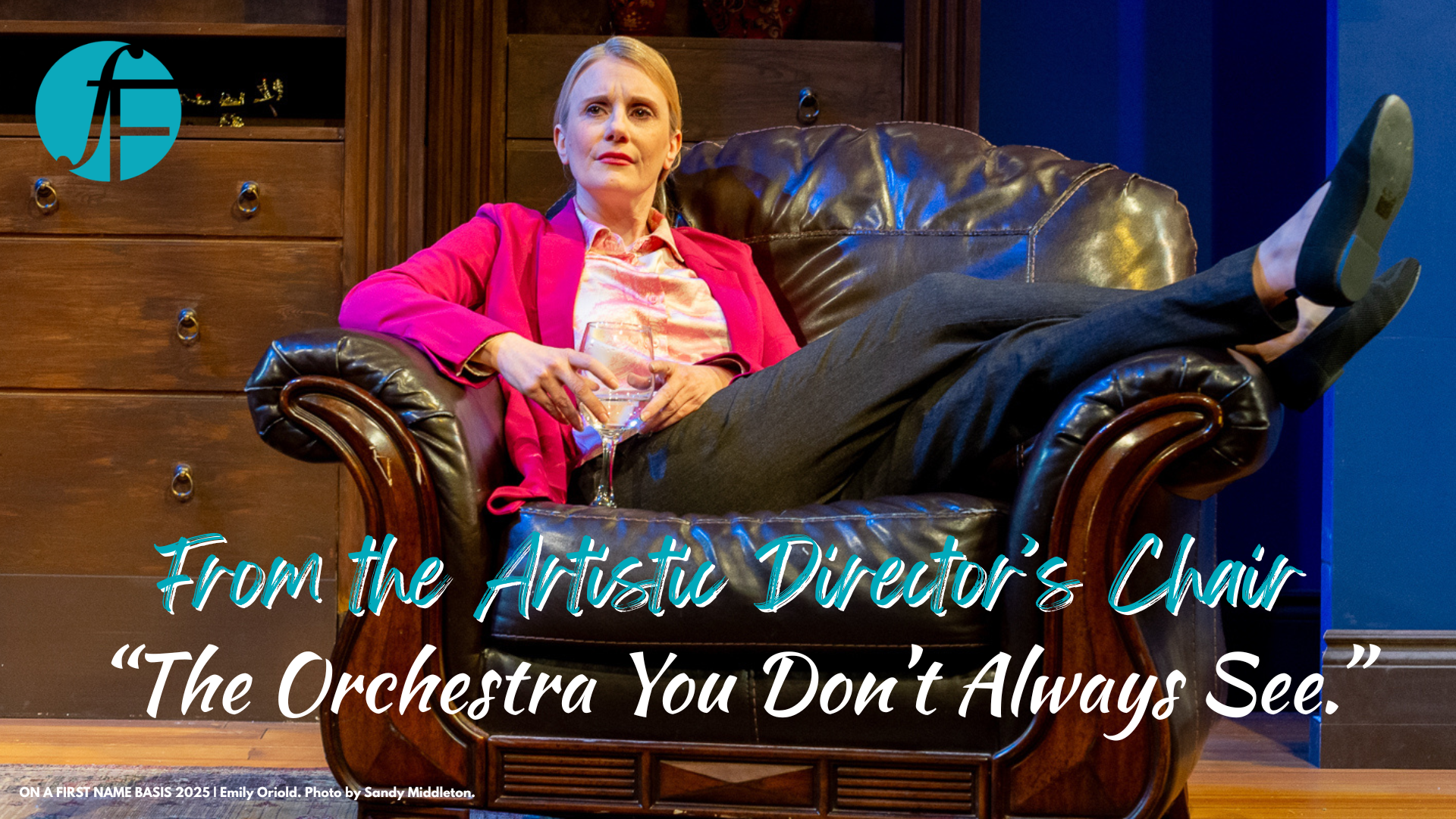
From the Artistic Director’s Chair Series – #9
“The Orchestra You Don’t Always See”
by Emily Oriold
This past week was our tech week and opening of The Beaver Club by Barb Scheffler at Lighthouse Festival Theatre. I talked a lot to the actors and crew about how directing a show like The Beaver Club is similar to conducting a symphony: words, lighting, music, projections, costumes, movement, and silence all come together to create something far greater than any one element could achieve on its own. Every cue, every transition, every shift in light or underscoring of music helps shape the emotional experience for the audience. It is the thrilling, delicate process of taking all of these individual artistic voices and finding harmony together onstage.
There comes a moment in every production process when the rehearsal hall begins to transform into something bigger.
For weeks, the director, actors, and stage management team live inside the script—mining rhythms, discovering relationships, finding the emotional truth of each moment. The rehearsal hall is where the bones of the story are built. It’s where the heart starts beating.
And then comes tech week.
Ah yes… the magical, exhausting, caffeine-fuelled marathon where theatre artists begin speaking almost entirely in cues and percentages.
“Can we take that light down by 15 percent?”
“Bump that sound cue by 2 points, please.”
“Everyone on deck for quick change rehearsal!”
“Take 15 while the ASM does their preset for the top of show.”
Tech week is where all the invisible storytelling elements finally join the dance.
Lighting, sound, costumes, props, set pieces, projections—all of them quietly supporting the emotional journey unfolding onstage. A subtle shift in lighting can isolate a character—we call these “specials.” A warm amber wash can suddenly make a scene feel nostalgic. The perfect musical transition can carry an audience emotionally from laughter into heartbreak before they even realize it’s happening.
Most audiences won’t consciously notice these things.
But they absolutely feel them.
Imagine watching a horror movie without music. Suddenly it’s just people screaming on screen, without the build up of tension. Or imagine a sweeping cinematic epic without those glorious John Williams horns soaring underneath the action. Music tells us when to hold our breath, when to hope, when to grieve, when to triumph.
Theatre works the same way.
Every artistic choice is another instrument in the orchestra.
And as a director, part of my job is to bring all of those instruments together—to listen carefully for balance, rhythm, tone, and emotional clarity. Directors become conductors of sorts, shaping not only performances, but the entire audience experience. Sometimes the smallest adjustment—a pause before a line, a light bump on a corner of the stage, a single sound cue arriving at just the right moment—can unlock something unexpectedly powerful.
That’s the beautiful thing about live theatre: hundreds of tiny pieces coming together in real time to create one shared experience.
It’s a puzzle. A symphony. Occasionally a controlled panic—we only have two days to bring it all together!
And somehow, what sometimes feels like against all odds, the lights dim, the audience settles in, and the story begins.
So the next time you join us at the theatre, I invite you to take in all of it. The fabulous performances by the actors, yes—but also the world surrounding them. Notice how the lighting makes you feel. Listen to how the music guides you. Watch how costumes help reveal character before a single word is spoken.
And if you happen to see someone backstage, in the wings speed-walking with a headset… just know: that’s theatre magic in motion.
I’ll see you at the theatre!
Emily Oriold,
Founder & Artistic Director