
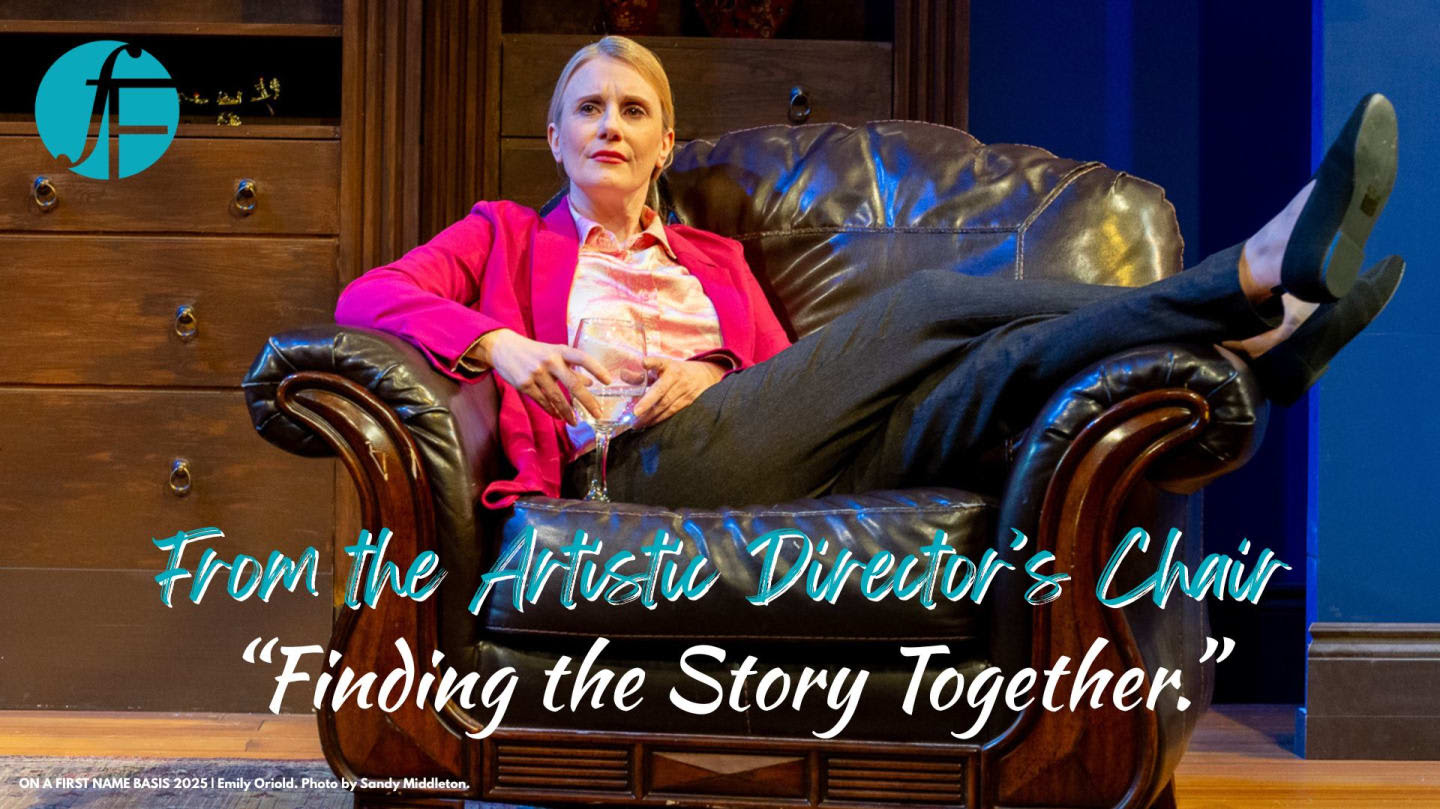
From the Artistic Director’s Chair Series – #8
“Finding The Story Together”
by Emily Oriold
As I pack my bags to head to Lighthouse Festival Theatre to direct The Beaver Club, I find myself thinking back to one of my earliest directing experiences: Chaplin: About Face at Talk Is Free Theatre in Barrie.
I had just ten days to create the piece with actor and writer, Jason Allin—a silent film on stage, woven together with reflections from “Chaplin” about his life. I remember being as sick as a dog through much of the process, but pushing through because the work demanded it and we had a finite amount of time to build it. During that time together, we laughed and laughed. It remains one of the most joyful times in my career, spending that time with Jason in the rehearsal hall.
And what we created… it was something special. The show found such a warm reception in Barrie that it eventually travelled to Theatre Aquarius in Hamilton. Since then, Jason has taken that work and run with it, touring as “The Chaplin Guy” across the world, from India to Japan to the United States. It’s extraordinary to witness the life a piece can take on.
Experiences like that are why I love the rehearsal process. There is something deeply fulfilling about walking into a room full of artists, each bringing their own piece of the puzzle, and building something together. When it works best, the rehearsal hall becomes a place of trust—a space that is collaborative, curious, and safe. No one piece is more important than another. We do it together.
Actors do their best work when they feel they can take risks, so I encourage exploration early on, trying things, asking questions, even getting it wrong. “Strong and wrong” is what we like to call it. We spend time digging into character and relationships, while also paying close attention to pacing and clarity. The rhythm of text is especially important in comedy. My role is to guide and shape, always in a way that empowers the actor’s instincts rather than overrides them.
When I begin to interpret a script and transform it into a visual performance, it starts with listening, really listening to what the script is asking for beneath the dialogue. From there, I imagine the physical world: how space supports relationships, how movement reveals character, and how rhythm shapes storytelling. I’m always asking, “What does the audience see that deepens what they’re hearing?” It’s about translating intention into images, behaviour, and timing so the story lives fully onstage. Even transitions between scenes become part of that storytelling language.
My favourite part of the process is that moment in rehearsals when everything starts to click, when the actors fully inhabit the world, the scenes find their rhythm, and you can feel what the audience’s experience will be. It’s a bit magical. I also love the early discussions sitting around the table, when the play is still full of possibility and discovery. That balance of exploration followed by clarity is what I find most rewarding.
Clarity of storytelling and a shared sense of purpose are what make a successful production. When everyone, actors, designers, stage management, is telling the same story, the audience feels it. And when that clarity is paired with authenticity, where the humour lands honestly and the emotional moments are earned, that’s when theatre truly connects. A successful production doesn’t just entertain, it invites the audience in and makes them feel part of something.
I have now had the privilege of directing over a dozen plays, and I look forward to many more in the years ahead. As I head into this next rehearsal hall, I carry with me a deep sense of gratitude, for the artists, the collaborators, and the trust that makes this work possible.
Back in the office, Jamie Williams and I often find ourselves deep in conversation about directing—how we approach a script, the choices we make, and the different ways we work with actors to mine authenticity in storytelling. Those conversations challenge and sharpen my own practice; they remind me that there is no single way in, only a shared commitment to truth, clarity, and connection. It’s a dialogue that continues to evolve, just like the work itself.
I invite you to join us this season with fresh insight and a renewed sense of excitement for the stories we’re telling. First up is the world premiere of The Bean by Norm Foster, running June 10–21 at Sons & Daughters Winery, directed by Jamie Williams.
I’ll see you at the theatre!
Emily Oriold,
Founder & Artistic Director